Understanding reliability and safety of mechanical components under repeated loading cycle is critical in many applications. Fatigue analysis predicts if and when components fail due to cyclic loading. At Resonant Engineering, we provide fatigue analysis that allows our clients to prevent failure, optimize material lifespan, and enhance the safety and performance of their designs.
Fatigue analysis evaluates whether a structure can endure repeated loading over time without significant material wear or failure. Unlike static stress analysis, which examines how a structure handles a single load event, fatigue analysis assesses the cumulative effects of multiple load cycles.
As cyclic stresses repeat, even at levels well below a material’s yield strength, microscopic cracks can initiate and grow, eventually leading to failure. Reducing peak stresses plays a critical role in extending fatigue life—cutting peak stress by just 10% can double a component’s durability. This makes managing stress concentration areas, especially those with sharp gradients, essential to enhancing long-term structural performance.
How to Perform Fatigue Analysis
Since fatigue is directly related to the component stresses, the first step is to perform a finite element stress analysis. Once the stress analysis is complete, the fatigue calculations can be carried out using one of the following techniques:
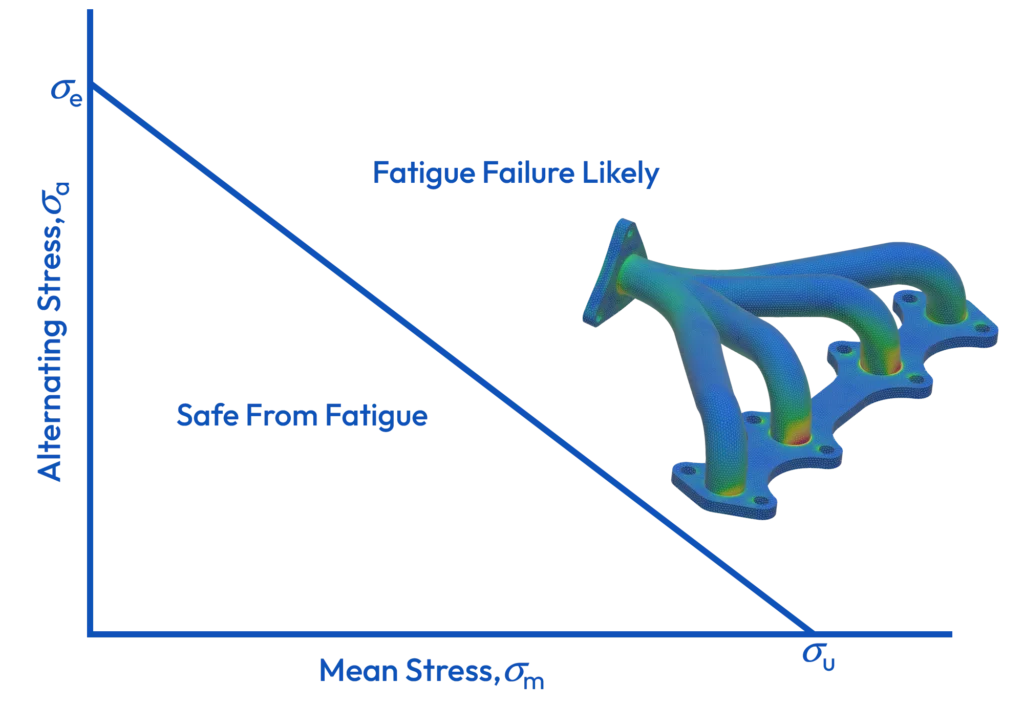
Endurance Limit Analysis
Endurance Limit Analysis is used to determine if a material has an endurance limit, below which it will never fail due to fatigue.
Stress-Based Fatigue Analysis
Stress-Based Fatigue Analysis is mostly used for high-cycle fatigue problems, where stresses are considerably below the material’s yield stress
Strain-Based Fatigue Analysis
Strain-Based Fatigue Analysis Is used for low-cycle fatigue, where stresses exceed yield stress and local plasticity occurs
Fatigue analysis often involves reviewing S-N (Stress-Number of cycles) or E-N (Strain-Number of cycles) curves. These curves provide a visual representation of stress or strain against the number of cycles until failure. With these experimentally-measured curves, it is possible to estimate how long a component will last under specific loading conditions.
Effect of Multiple Simultaneous Loads
Fatigue analysis becomes more complex when a structure is subjected to multiple loads acting at once or in varying sequences. In a single load case, the process is straightforward, but when several load cases (such as forces, moments, or internal pressures) are present, a cumulative fatigue analysis is required.
Miner’s Rule is commonly used in these scenarios, where the cumulative damage from each load case is calculated and summed to predict when the component will fail. This method assumes that the damage caused by each cycle is proportional to the number of cycles. However, real-world scenarios may differ, especially if plasticity is involved, making it crucial to understand the sequence of loading for accurate fatigue predictions.
Protect Your Design Success
Fatigue analysis can help you to ensure the durability and safety of your components. At Resonant Engineering, we provide fatigue analysis services that help you assess and predict the behaviour of your structures under repeated loading conditions. Whether you are designing more robust components or working to prevent future failures, our services deliver the insights necessary to enhance the reliability of your structures.
Chat with our engineering team
1
Hi, welcome to Resonant Engineering
Have a question about our services?
Click the button to chat with our engineering team on WhatsApp.