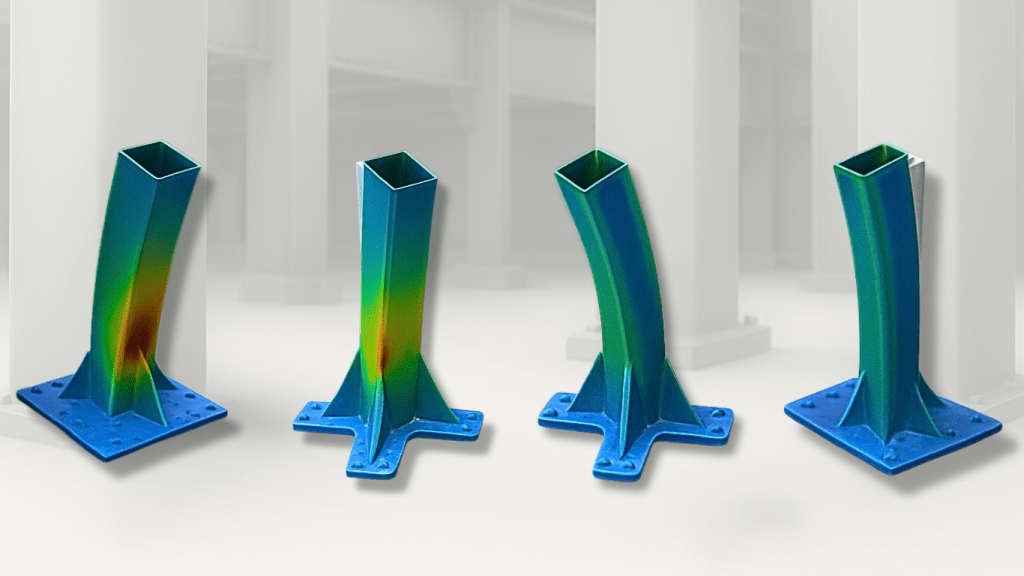
Ensuring the structural integrity of a product is essential to its success and reliability. Stress analysis, also known as strength assessment, provides critical insights into whether a design will meet strength and integrity requirements. Using finite element analysis (FEA) results, Resonant Engineering helps clients identify potential issues and optimize their designs for structural safety, efficiency, and performance. Our client-focused approach delivers actionable insights to enhance design performance, reduce material costs, and ensure compliance with structural integrity requirements.
Stress analysis is a key process in mechanical engineering used to evaluate whether a product design can withstand the loads it will experience during operation. It typically involves evaluating stress, strain, and displacement results from finite element analysis and deciding if the design is suitable.
Unlike fatigue analysis, which predicts failure due to repeated loading cycles, stress analysis focuses on static loads to assess whether a structure will fail after a single load application. By identifying weak points and potential failure locations, product design can be corrected before an entry to market, ensuring suitability for purpose and reducing the risk of costly redesigns.
Evaluating Finite Element Analysis Results
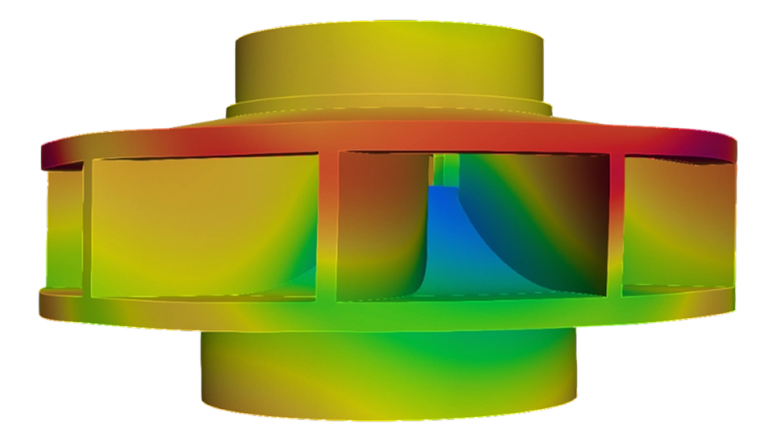
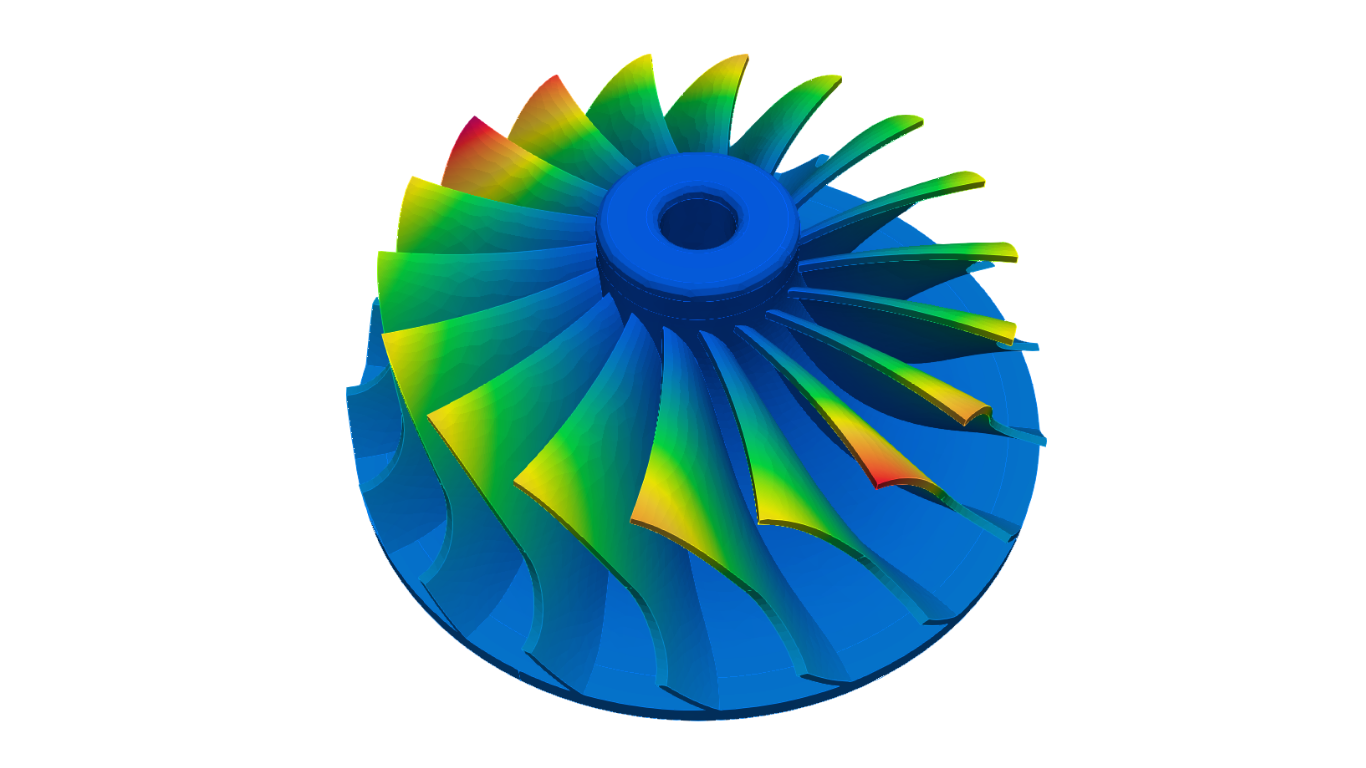
Finite element analysis generates complex stress data that must be simplified for practical interpretation. An engineering characteristic known as an equivalent stress provides a single value representing the combined effects of stresses in multiple directions. There are a number of definitions of equivalent stress, and selecting the appropriate one depends on material behaviour and industry standards. Most commonly, Von Mises stress is used for ductile materials, while principal stresses are used for brittle materials.
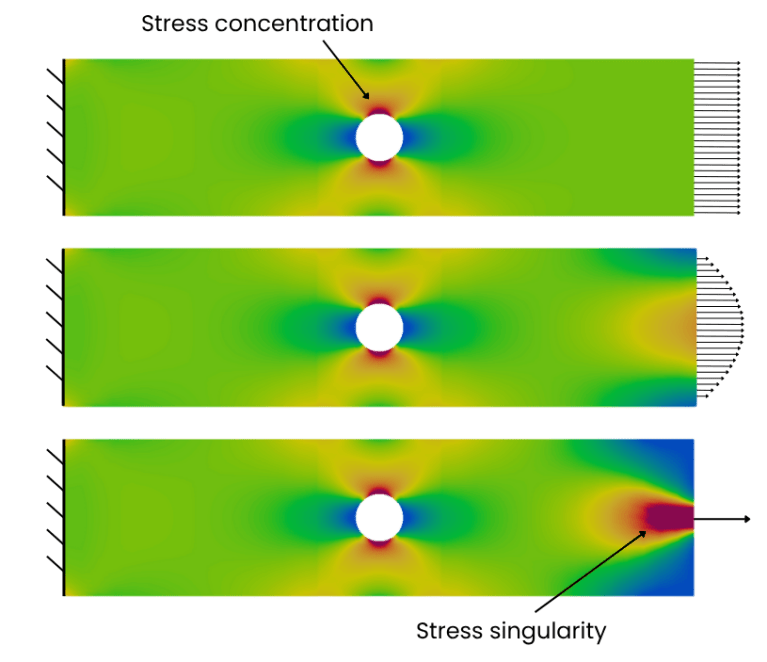
When evaluating FEA results, factors related to modelling decisions must be correctly considered when calculating equivalent stress, particularly stress concentrations and stress singularities.
Stress Concentrations
Stress concentrations are localized increases in stress around geometric features such as holes or notches. If detailed features are included in the model, the stress distribution should be accurately represented. However, if used model has limited detail, such as when using shell models, correction factors are applied to avoid overestimating strength.
Stress singularities
Stress singularities are theoretical points of infinite stress caused by modelling assumptions rather than physical reality. Singularities typically occur at boundaries or points where concentrated loads are applied. While stress results close to the singularities are affected, broader stress fields remain valid. Recognizing and managing singularities allows accurate interpretation of results without compromising model simplicity and speed.
Safety Factor and Design Suitability
A key outcome of stress analysis is determining the Coefficient of Safety (CoS), which compares a structure’s load-carrying capacity to material limits:
Coefficient of Safety (CoS) = Allowable Stress / Calculated Stress
A similar coefficient can be calculated using other structural characteristics, such as displacement or strain, if this is more appropriate for a given application. Theoretically, a design is acceptable if the CoS exceeds 1. Practically, higher design coefficients are often used. For normal operational loads (so-called limit loads), a coefficient of safety above 1.5 is common. For extreme, once-in-a-lifetime loads (also known as ultimate loads), lower CoS are often acceptable. CoS must be evaluated for all critical design places, including high-stress regions, connection points, or welds. The lowest CoS across the design determines its overall coefficient of safety.
Partnering for Design Success
Stress analysis is a tool that drives better design decisions. Partnering with Resonant Engineering ensures your design process is guided by actionable insights that improve structural safety, efficiency, and performance. Our expertise helps translate finite element analysis results into practical design improvements, streamlining your development cycle and reducing time-to-market.
Chat with our engineering team
1
Hi, welcome to Resonant Engineering
Have a question about our services?
Click the button to chat with our engineering team on WhatsApp.