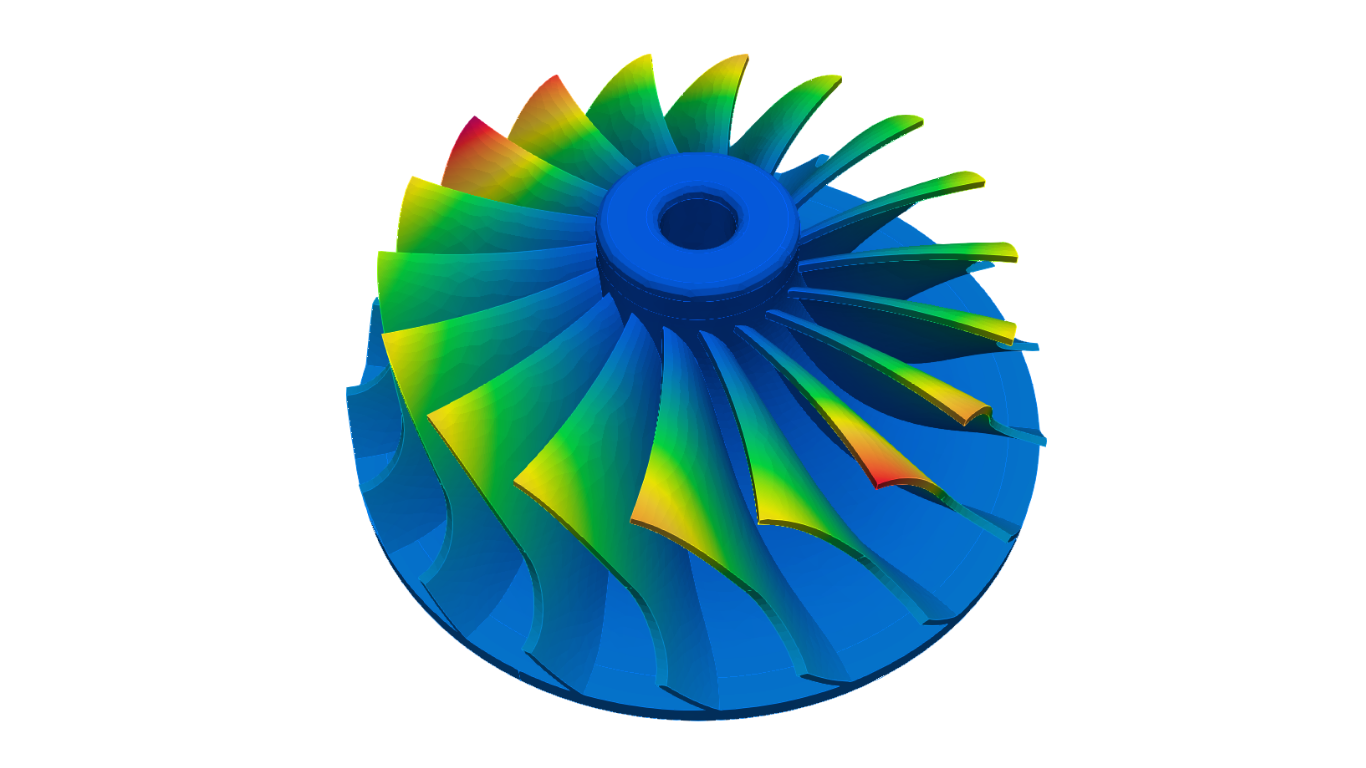
Closed, multi-blade impellers are susceptible to resonance due to interaction between blade passing excitation and structural modes, requiring verification that resulting dynamic stresses remain within acceptable fatigue limits
Solution
Modal and harmonic analysis of the rotating impeller was performed to evaluate excitation frequencies, dynamic response, and resulting stress amplitudes, with fatigue assessment carried out using an ISO‑aligned stress‑life approach.
Results
Stable dynamic behaviour with adequate separation from resonant excitation and low stress amplitudes confirms minimal risk of high‑cycle fatigue under expected operating conditions.
Challenge
Technical Background
Centrifugal pump impellers operate under combined steady and dynamic loading, including centrifugal stresses and fluctuating hydraulic forces. In multi-blade configurations, periodic excitation, primarily at the blade passing frequency (BPF), can interact with structural natural frequencies, potentially leading to resonance. This interaction may result in amplified vibration and cyclic stresses concentrated at critical locations such as blade roots and the hub–blade interface. If not properly assessed, these stresses can drive high-cycle fatigue, increasing the risk of crack initiation and reducing component life in demanding operating environments.
Industry Standards
In industrial practice, centrifugal pump design is governed by API 610, which defines requirements for mechanical integrity, vibration control, and operational reliability. While API 610 does not prescribe detailed fatigue assessment methods, evaluation of cyclic stresses is typically performed using stress-based approaches aligned with ISO fatigue standards (e.g., ISO 12107) and established high-cycle fatigue methodologies. These approaches combine modal analysis, excitation identification, and stress evaluation to verify that dynamic stresses remain within acceptable limits, supporting reliable long-term operation under cyclic loading.
Approach
Impeller Dynamic Stress Assessment
Engineering followed a structured analysis workflow:
Geometry idealisation and model preparation – Closed impeller CAD simplified while preserving blade geometry, hub, and shroud features critical to dynamic behaviour.
Modal analysis (rotating) – Identification of natural frequencies and mode shapes to characterise blade and disk behaviour.Inclusion of centrifugal stiffening effects to capture frequency shifts across operating and overspeed conditions.
Excitation definition – Blade passing frequency (BPF) and relevant harmonics determined based on rotational speed and blade count.
Campbell diagram evaluation – Comparison of excitation lines with natural frequencies to assess resonance risk and frequency separation.
Harmonic response analysis – Distributed harmonic loading applied to blade surfaces to simulate hydraulic excitation and quantify dynamic stress amplitudes.
Fatigue assessment – Stress amplitudes evaluated at critical locations using an ISO‑aligned stress–life (S–N) approach.
Engineering interpretation – Results reviewed to confirm acceptable stress levels and low risk of resonance-induced fatigue.
Key API 684 Rotor Dynamics Criteria Evaluated:
Separation between structural modes and blade passing frequencies
Dynamic stress amplitudes under blade passing excitation
Fatigue resistance based on stress–life (S–N) methodology
Separation between structural modes and blade passing frequencies
Dynamic stress amplitudes under blade passing excitation
Fatigue resistance based on stress–life (S–N) methodology
Our dynamic assessment confirmed adequate separation between blade passing excitation and structural modes, with low stress amplitudes indicating minimal risk of fatigue failure in the impeller.
Solution
A detailed finite element model of a closed centrifugal pump impeller was developed to evaluate dynamic behaviour under representative operating conditions. Modal analysis was conducted for both non-rotating and rotating configurations to capture centrifugal stiffening effects and identify critical modes. Blade passing frequency (BPF) excitation was defined based on rotational speed and applied through harmonic response analysis using distributed loading on blade surfaces. Resulting stress amplitudes at critical locations were evaluated against material fatigue limits using an ISO‑aligned stress–life approach, providing a robust assessment of dynamic integrity.
Results
The analysis demonstrated that the impeller operates with adequate separation between blade passing excitation and structural modes, avoiding resonance within the operating range. Predicted dynamic stress amplitudes at critical locations, including blade roots, remain within acceptable fatigue limits, indicating a low risk of high‑cycle fatigue failure. From an operational perspective, this supports reliable impeller performance, reduces the likelihood of crack initiation and component failure, and contributes to improved durability and reduced maintenance requirements in demanding service environments.
Industry Context
Importance of Dynamic and Fatigue Analysis of Rotating Equipment
Centrifugal pump impellers are critical rotating components responsible for transferring energy to the fluid while operating under combined steady and fluctuating loads. Their structural integrity is essential for maintaining pump performance and reliability. However, periodic excitation (primarily from blade passing frequency (BPF)) can interact with structural modes, leading to resonance, elevated vibration, and cyclic stresses. If not properly assessed, these effects may result in high-cycle fatigue, causing crack initiation, blade damage, and potential component failure.
Industry standards such as API 610 define requirements for pump reliability, vibration control, and mechanical integrity, while ISO fatigue-related standards provide guidance for evaluating material behaviour under cyclic loading. The combined application of modal, harmonic, and fatigue analysisenables accurate prediction of impeller dynamic response under representative operating conditions. In practice, this supports improved design robustness, reduced risk of failure, and enhanced operational reliability in critical industrial pumping applications.
Chat with our engineering team
1
Hi, welcome to Resonant Engineering
Have a question about our services?
Click the button to chat with our engineering team on WhatsApp.