As simulation tools become more powerful and accessible, many organisations ask the same question: can FEM analysis replace physical testing? The short answer is that while simulation can significantly reduce development costs, shorten design cycles, and improve engineering confidence, it cannot eliminate testing in every situation.
The real value comes from understanding what FEM analysis can predict reliably, what its limitations are, and how simulation and testing work together to support robust engineering decisions. This article explores where FEM analysis excels, where testing remains essential, and how to use both effectively throughout product development.
How Accurate Is FEM Analysis?
Finite Element Analysis can deliver highly accurate predictions when the model accurately represents the real-world system being investigated. Material properties, loads, boundary conditions, contact behaviour, and meshing strategy all influence the quality of the results.
When these inputs are well understood, FEA can often predict structural behaviour with a high degree of confidence.
However, an FE model is always a simplified representation of reality. Every simulation involves assumptions about geometry, manufacturing tolerances, material behaviour, operating conditions, and user-defined modelling choices. The accuracy of the results therefore depends not only on the software but also on the quality of the engineering judgement behind the model.
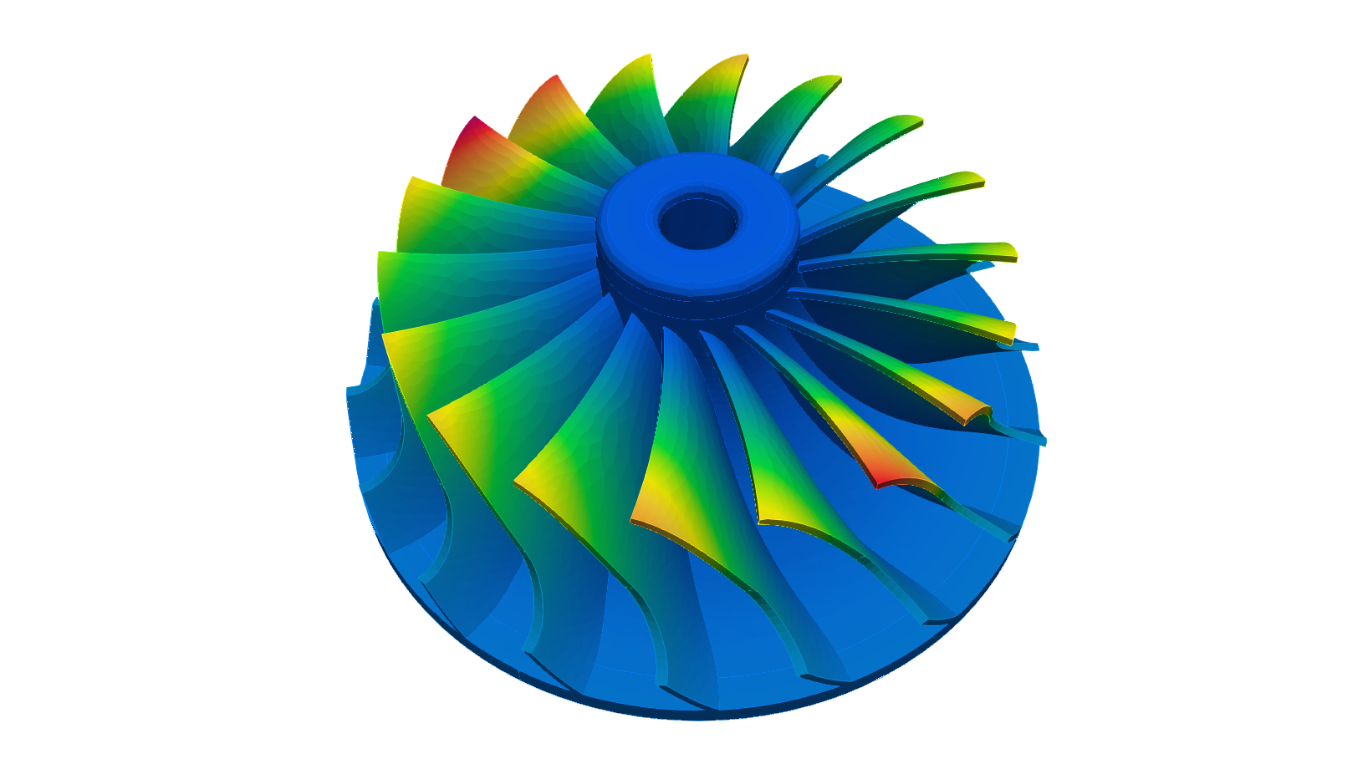
For this reason, experienced analysts focus as much on validating assumptions as they do on generating results. A simulation showing impressive stress contours is only valuable if the underlying model accurately represents how the structure behaves in service.
What Are the Limitations of FEA Simulation?
FEM analysis is an extremely powerful engineering tool, but it is not a substitute for understanding the physical system being modelled. The software can only analyse the conditions provided by the engineer. If loads, constraints, material properties, or contact behaviour are incorrect, the results will also be incorrect regardless of the sophistication of the analysis.
Some engineering problems are also inherently difficult to simulate accurately. Highly nonlinear contact conditions, material failure, wear, manufacturing defects, frictional behaviour, and complex environmental effects may be challenging to represent with complete confidence. Even where advanced analysis methods exist, uncertainties in the input data can still dominate the accuracy of the prediction.
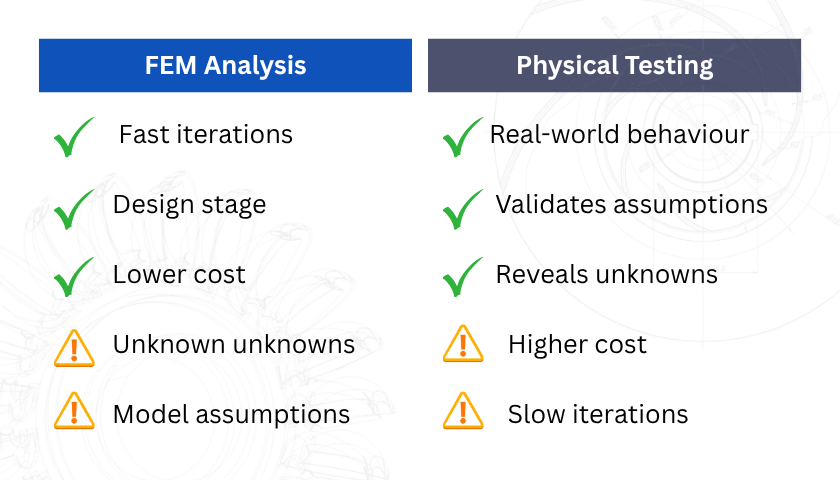
Another limitation is that FEM analysis can only assess the scenarios that have been modelled. Physical testing occasionally reveals unexpected behaviours that were not anticipated during the simulation phase. These are often called “unknown unknowns”. This is one reason why testing remains an important part of engineering verification and validation, particularly for safety-critical or high-value systems.
When to Use FEM Analysis
FEM analysis is most valuable when answering engineering questions that cannot be solved with confidence using simple calculations or engineering judgement alone. It is commonly used to determine whether a design will withstand its operating loads, identify highly stressed regions, assess vibration behaviour, evaluate fatigue life, or investigate the root cause of a failure.
The technique is particularly useful during the design phase, where simulation can identify issues before manufacturing begins. It is also widely used before physical testing to predict likely outcomes, optimise test programmes, and reduce development costs. In many projects, FEA and testing work together, with simulation guiding design decisions and physical testing providing final validation.
When Is the Right Time to Perform Physical Testing?
Physical testing is most effective when used alongside simulation rather than as an alternative to it. During the early design stages, FEM analysis can be used to evaluate concepts, compare design options, and identify potential weaknesses before any hardware exists. This allows engineers to focus resources on the most promising solutions.
As the design matures, testing becomes increasingly valuable for validating assumptions, verifying performance requirements, and confirming that the physical product behaves as predicted. In many projects, simulation is used first to guide the design process, while testing provides final evidence that performance targets have been achieved.
The most efficient development programmes use both approaches strategically. Simulation reduces the number of design iterations and prototypes required, while testing provides confidence that the product will perform reliably under real operating conditions. Used together, they often deliver better results than either approach alone.
Frequently Asked Questions
In most engineering applications, no. While FEM analysis can answer many design questions before hardware is available, physical testing remains necessary for validating assumptions, confirming real-world behaviour, and satisfying certification or customer requirements. Simulation can significantly reduce testing effort, but complete replacement is rarely appropriate for critical engineering decisions.
Differences usually arise because the real structure does not behave exactly as assumed in the model. Material properties may vary from specification, boundary conditions may be more flexible than expected, manufacturing tolerances may influence performance, or some loading conditions may not have been fully captured. Simulation and testing are therefore best viewed as complementary tools that help improve understanding of the system.
The most common sources of error include incorrect loads, unrealistic boundary conditions, inaccurate material properties, poor mesh quality, oversimplified geometry, and inappropriate modelling assumptions. In many cases, uncertainty in the input data has a greater influence on result accuracy than the numerical solver itself. This is why model verification and engineering judgement remain critical parts of any FEA project.
Physical testing is particularly important when demonstrating compliance with industry standards, validating new technologies, investigating complex failure mechanisms, certifying safety-critical systems, or confirming performance where significant uncertainty exists in the model assumptions. Testing may also be required by customers, regulators, or certification bodies regardless of the quality of the simulation.
The most effective approach is often to use FEA early to predict behaviour and identify critical areas, then perform targeted testing to validate the model. Test data can be used to refine assumptions, improve future simulations, and increase confidence in the final design. This iterative approach helps reduce development risk while ensuring that engineering decisions are supported by both analytical and physical evidence.

Written by
Vaclav Ondra
Director of Resonant Engineering, specialising in finite element analysis (FEA), vibration consultancy, rotordynamics, and structural integrity of mechanical systems and rotating machinery.