Machinery vibration is present to some degree in almost every mechanical system. While low vibration levels are often acceptable, excessive vibration can significantly reduce reliability, shorten equipment life due to the high cycle fatigue, increase maintenance costs, and create safety concerns. The risk of negative vibration impacts scales with vibration amplitude. Therefore, all these issues are best prevented by proper design choices, particularly resonance avoidance, at early design stages.
Machinery Vibration Prevention via Resonance Avoidance
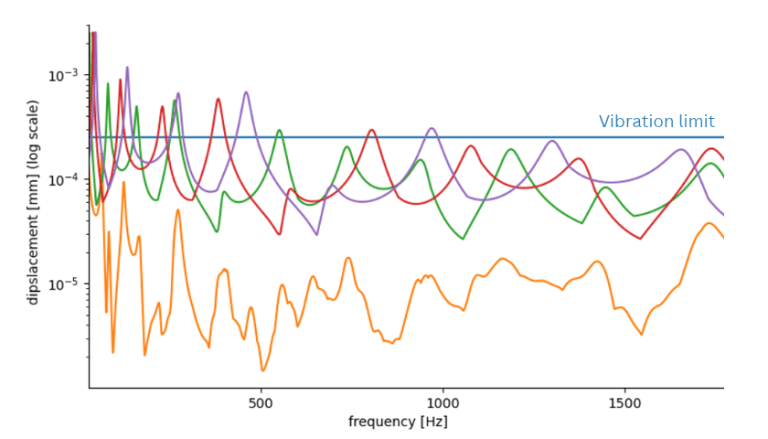
Resonance in mechanical systems occurs when the system’s natural frequency matches the frequency of external excitation, resulting in a significant amplification of vibration amplitude. This phenomenon can severely compromise performance, reduce the lifespan of components, or even cause catastrophic failure if left unmanaged. It is therefore important to maintain a safe frequency separation between the excitation and natural frequencies. This is known as resonance avoidance.
There are exceptions to this, however. While resonance is almost always viewed negatively due to its potential to cause damage, it isn’t always undesirable. In fact, in some systems, resonance is essential for proper function. For instance, piezoelectric actuators rely on resonance to achieve large displacements from small electrical inputs, and tuned mass dampers must be tuned to resonance at the frequency of the underlying excitation.
In the majority of cases in industrial practice, resonance is undesirable because it amplifies external excitation. Common excitation sources include shaft imbalance, vertical and horizontal misalignment, gear mesh and its harmonics, blade-pass frequency, ground motion, or fluid-induced vibration. All such excitation inputs should be understood as well as possible, as early as possible in the design process, to correctly tune the natural frequencies of components and systems. Without understanding the system’s excitation, proper design and resonance avoidance are not possible, and excessive vibration may occur once the system enters operation.
Removing high machinery vibration
When high vibration and its negative consequences do occur, it is still possible to remedy (mitigate) them. However, with already manufactured components, the options are limited, reactive, and usually costly.
Common approaches include:
- Shifting the natural frequencies - The natural frequency of a system depends on its mass and stiffness. Therefore, increasing or decreasing stiffness and/or mass, for example by adding reinforcements or ribs, or using lighter components, can shift the natural frequencies out of the excitation range and prevent resonance.
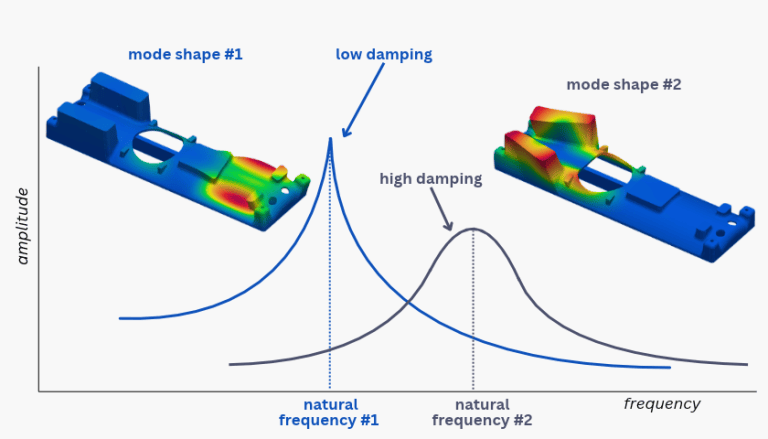
- Introducing damping - Damping reduces the amplitude of vibration at resonance without changing the natural frequency. This means resonance still occurs, but its impact is minimised. Viscoelastic materials, dashpots, or damping coatings can be added to the system to absorb energy. Increasing damping is sometimes a more practical solution when frequency shifting isn't feasible due to design constraints.
- Altering the excitation source - If the external excitation can be avoided or modified, resonance can be sidestepped entirely. Depending on the structural system, approaches such as changing the operating speed, isolating the structure from dynamic loads, rebalancing, or redesigning the excitation load paths may be effective.
- Adding vibration management technologies - Vibration management technologies are often implemented via secondary systems designed to absorb energy at specific frequencies. Devices such as tuned mass dampers or advanced isolation systems are commonly used in industrial machinery, civil structures, and precision equipment. Designing these devices requires careful consideration to match the problematic frequency, but they have the potential to reduce vibration amplitudes by orders of magnitude without redesigning the primary structure.
- Using active vibration control - In high-end or highly sensitive applications, active vibration control can be employed. This approach uses sensors, actuators, and controllers to cancel vibrations in real time. While complex, it is used in applications such as precision optics, aerospace systems, semiconductor manufacturing equipment, and advanced isolation platforms.
While these fixes can be effective, they carry their own risks and require trade-offs. Any hardware modification typically requires requalification, downtime, and sometimes structural rework. Therefore, deploying changes into already operating systems is slow and costly compared to early prevention during design.
Moreover, retrofits seldom work without influencing the behaviour of the wider system. For example, modifications that shift natural frequencies or add damping may successfully eliminate vibration at one location while introducing new issues at different frequencies or elsewhere in the structure. Effective remediation should therefore be guided by careful engineering assessment rather than by simply adding reinforcement or increasing structural mass.
Fixing the machinery vibration of existing systems is possible, but it is usually difficult and expensive. In contrast, it is far more efficient to consider vibration early in the design stage and avoid vibration problems altogether.
When Should Machinery Vibration Be Analysed?
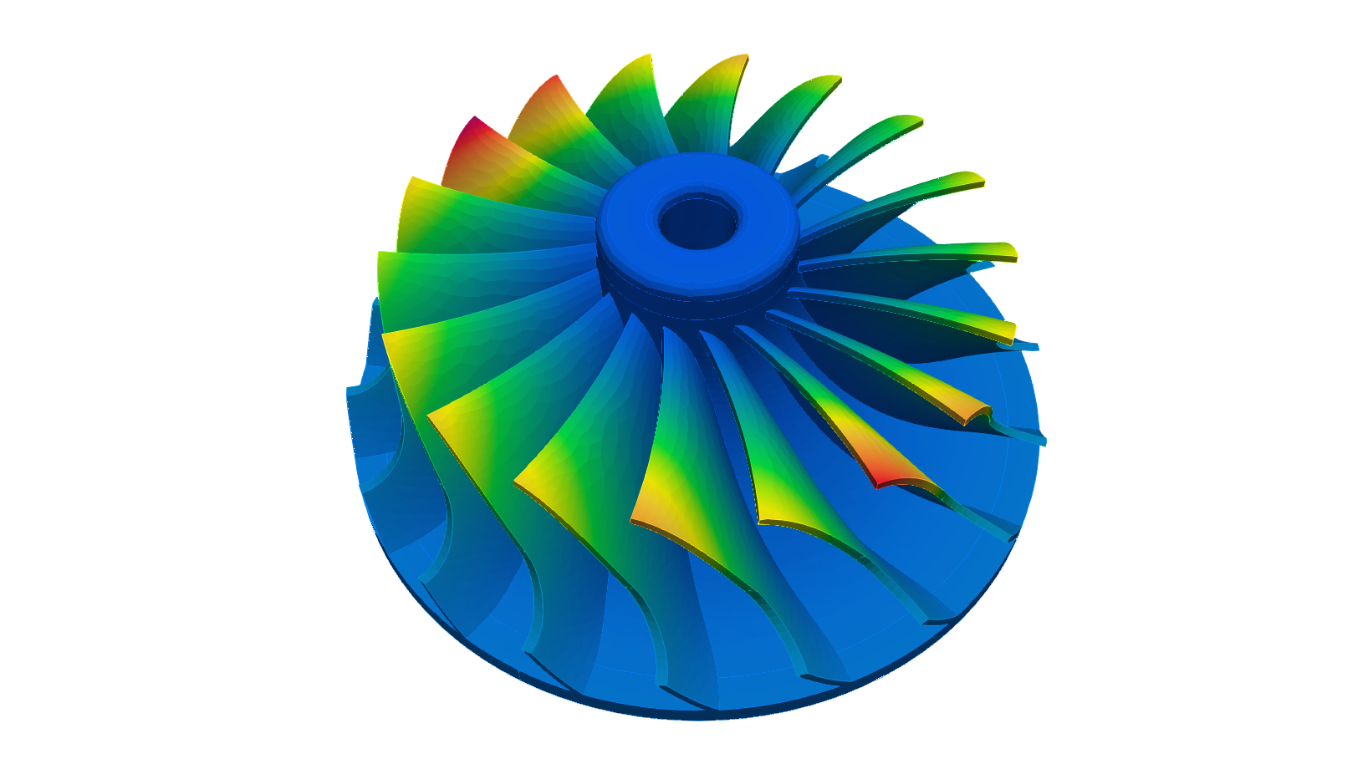
The most effective time to assess machinery vibration is during the concept and design stages, before major design decisions become fixed. At this point, engineers can evaluate natural frequencies, mode shapes, damping, and expected excitation sources using analytical methods, finite element analysis (FEA), or experimental testing of prototypes.
As a design progresses, vibration assessments can be used to verify adequate separation between operating frequencies and natural frequencies, identify potential resonances, and evaluate the effectiveness of any vibration mitigation measures. Early analysis reduces technical risk and helps eliminate costly modifications later in the project lifecycle.
Frequently Asked Questions
FEM (Finite Element Method) is the mathematical technique used to solve engineering problems, while FEA (Finite Element Analysis) is the practical application of that method to a specific design or engineering challenge. In everyday engineering practice, the terms are often used interchangeably, although FEM technically refers to the underlying mathematics and FEA refers to the complete simulation process.
Common causes include rotor imbalance, shaft misalignment, gear mesh forces, blade-pass excitation, fluid-induced vibration, looseness, external ground vibration, and resonance caused by a match between the excitation and natural frequencies.
Typical indicators include increased noise, visible vibration, recurring maintenance issues, repeated bearing or seal failures, loosening fasteners, fatigue cracks, and abnormal readings from vibration monitoring systems.
In many cases resonance can be avoided through design changes that separate natural frequencies from operating frequencies. Where complete avoidance is not practical, damping, isolation, or vibration control systems can often reduce vibration to acceptable levels.
Preventing vibration during the design phase is almost always more cost-effective. Early design modifications are generally straightforward, whereas fixing vibration in existing equipment often requires downtime, redesign, testing, installation work, and operational disruption.

Written by
Vaclav Ondra
Director of Resonant Engineering, specialising in finite element analysis (FEA), vibration consultancy, rotordynamics, and structural integrity of mechanical systems and rotating machinery.